
 I was first introduced to the Anthurium when I moved to Hawaii at age 21 way back in 19___ (long time ago). I was planning to go back to Minnesota for Christmas and when the mailman who delivered mail to my office heard about it, he delivered to me two large boxes of Anthuriums that had already been passed through agricultural inspection.
 My parents were thrilled to get these unusual flowers and they lasted for several months after Christmas.
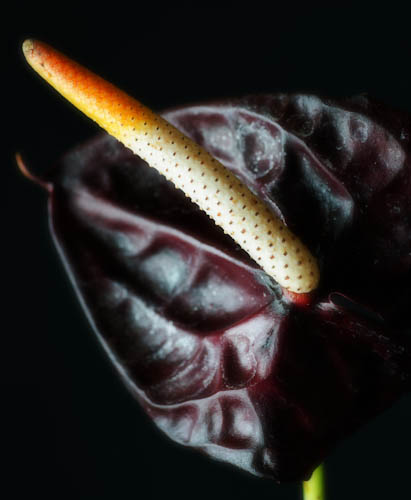
I think these Anthuriums are past their prime. Normally the flower is a bright red – these are almost a red-black. But seeing Anthuriums always bring back wonderful memories of that Christmas and the kindness of the mailman.
 Maralee
 Through My Lens
Nice image, colours , lighting and presentation, Maralee.
Thank you, Mike.
Nice photos. Yes, definitely past their prime. Not only are they usually bright read, the spadix is usually a bright yellow. (I had to look that term up….and learned that the spadix is actually the flower! The red part is a leaf. Go figure! http://www.ehow.com/list_5876323_parts-anthurium-plants.html)
But you really are making me homesick. 😉
Wait, I think I’m confused. But who wouldn’t be confused by a flower that seems to last forever!
These were definitely past their prime. They weren’t the bright red color they usually are and the spadix (I didn’t know what that was called, either) was drying out at the ends.
What a stunning and unusual color this … is. One of my favorite flowers – good because the last long when put in vase.
The unusual color came from them being too old, I think. They’re usually a bright red.
I think there are some darker red varieties and also some lighter toward pink colors and some whites, but the “spad” should never be shriveling or off color. Either the brown bumps along the base or the checkered tips would have made me pass them up no matter how cheap they were, back in the days when I owned a flower shop.
Your shots brought out the best in the flowers and made for stunning photos.
They came along with the heliconia and the orchid. I really just wanted the heliconia. 🙂